
Articles on Theology and Leadership

Tag: Motivation

Motivation Matters (Leadership)

Are results the final metric of success? The bottom line is much more than finances or growth metrics when it comes to leadership. The end doesn’t always justify the means. Good leaders will seek to understand the dynamics of motivation, but great leaders know it matters and why. 

What is Motivation?

Deci and Ryan (2018) succinctly outlined the etymological thrust of motivation as “what moves people to action” (p. 13). A misunderstanding or mishandling of motivation typically focuses solely on the action without regard to what moves people and at the expense of the people themselves. It is often framed as either intrinsic or extrinsic. Intrinsic motivation moves people to action based on their inherent drives and desires, and extrinsic motivation moves people to action due to external stimuli. 

Why Does Motivation Matter?

Leaders in all types of organizational contexts heavily rely upon “assumptions about human potential and individual performance that are outdated, unexamined, and rooted more in folklore than in science” (Pink, 2009, p. 9). Accordingly, they “pursue practices such as short-term incentive plans and pay-for-performance schemes in the face of mounting evidence that such measures usually don’t work and often do harm” (Pink, 2009, p. 9). 

Motivation matters because it is the difference between treating symptoms and finding the cure. Throwing a pizza party may grant a shot in the arm to office morale, but if people feel unheard, unfulfilled, and micromanaged, the positive impact will be short-lived. It may also morph into resentment. 

Motivation matters because people aren’t merely raw materials to accomplish goals. Loyalty and longevity evaporate when employees are viewed as expendable pawns to get the desired checkmate. Productivity also suffers. Schwartz (2010) contrasted short-term superficial productivity by fear and squeezing with a larger perspective of rest, renewal, and reflection. What good is a bump in sales in the first quarter if your workforce turnover rate skyrockets in the third quarter? People aren’t expendable, and the human spirit is no mere expenditure in pursuit of profit. 

Motivation matters because understanding it and effectively wielding it is a severely untapped resource. “Research consistently shows that people who experience meaningful work report better health, more well-being, and a clearer sense of teamwork and engagement” (Hansen, Amabile, Snook, and Craig, 2018, p. 94). Because every person is unique, there is no universal method to leverage motivation. 

Intrinsic Motivation

Advocates for intrinsic motivation tend to paint reliance on external stimuli as harmful. Extrinsic and intrinsic motivation aren’t opposites like good and evil. They are a complex intermix of personality, need, and desire that wise leaders learn to tap into appropriately within the proper contexts. Minimizing aspects like compensation, benefits, and bonuses can be as counterproductive as ignoring autonomy, competence, and relatedness. 

Nonetheless, the drive for results often leads to reliance on incentives and punishments instead of improving communication, fostering teamwork, or improving emotional intelligence. Using carrots and sticks impacts compliance; however, there is a tradeoff. Contrasting the era of compliance with a new emerging philosophy of work, Thomas (2010) highlighted the sufficiency of extrinsic rewards in the past to “buy rote behavior” and their failure to “appeal to workers’ passions, commitment, initiative, or even enlist much of their intelligence” (p. 6). 

Striking the Balance

Leading well and learning well are inextricable. Great leaders will round out their leadership repertoire with tools that encompass the well-being of their organization and their people. That means having the appropriate extrinsic motivational paradigms to meet needs and operating with a capacity to learn and grow in intrinsic motivational paradigms by which people feel valued, connected, and empowered.

Three C’s to Get Started

Communication, caring, and community is by no means an exhaustive list of areas to cultivate intrinsic motivation, but they are a starting point. The practices listed below represent my experience as an employee and leader over the past twenty years. 
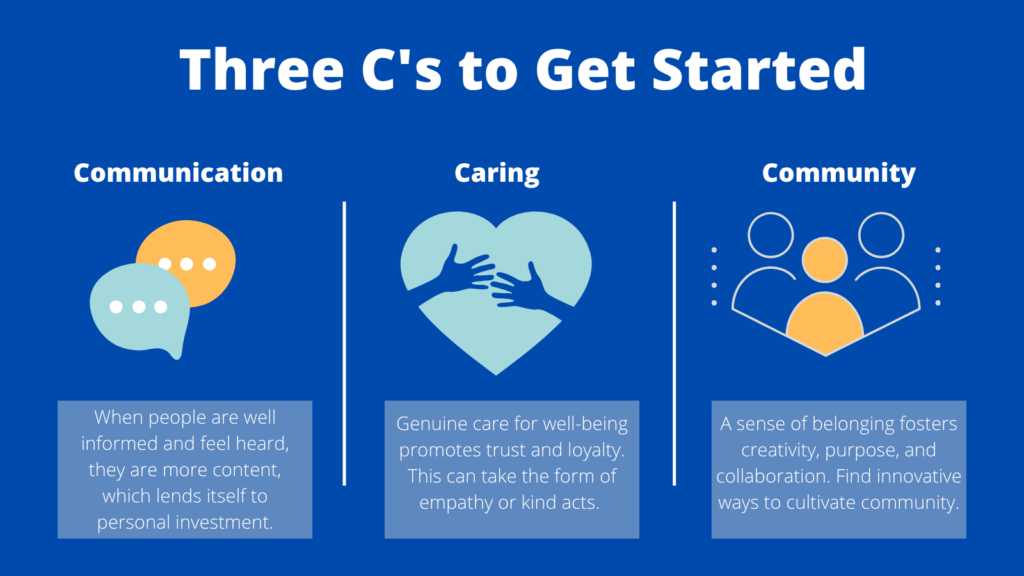
Communication

  • Strive for clarity and make your communication as concise as possible
  • Use multiple channels to communicate the same message 
  • Find ways to integrate your personality as you speak, write, and facilitate discussions
  • Always assume that you’ve under-communicated

Caring

  • Schedule regular check-in meetings
  • Use informal conversations to stay updated on people’s lives
  • Regularly check to see that people’s tangible needs are being met
  • Make mental health a part of creating an environment where people are cared for

Community

  • Encourage and provide the means for networking and professional development
  • Provide opportunities and participate in chances to be together in informal contexts
  • Be mindful of including remote workers and intentional to schedule time together with digital teams
  • Celebrate wins together

I’ve had the privilege to work for leaders who practiced these concepts, and I’ve had the misfortune of serving under leaders who misunderstood or disregarded motivation. The first kind of leader inspired everyone in the organization to strive for greatness, while the second contributed to a toxic work environment.

Motivation probably seems like an abstract idea more than a leadership strategy. It isn’t an easy concept to get your head wrapped around or practically implement. It takes time, willingness to learn, flexibility, and a genuine desire to harness motivation’s power to invest in people. Far more than the practical benefits, motivation matters because people matter.

References

Harvard Business Review, Morten T. Hansen, Teresa M. Amabile, Scott A. Snook, & Nick Craig. (2018). Purpose, Meaning, and Passion (HBR Emotional Intelligence Series). Harvard Business Review Press.

Pink, D. H. (2009). Drive: The surprising truth about what motivates us. New York, NY: Riverhead Books.

Ryan, R. M., & Deci, E. L. (2018). SELF-DETERMINATION THEORY: Basic psychological needs in motivation, development, and wellness. S.l.: GUILFORD.

Schwartz, T. (2014, July 23). The Productivity Myth. Harvard Business Review. Retrieved May 14, 2022, from https://hbr.org/2010/05/the-productivity-myth-2 

Thomas, K. W. (2010). Intrinsic motivation at work: What really drives employee engagement. San Francisco: Berrett-Koehler.

The Paradox of Obedience and Motivation

When does God despise obedience? Why would God command us to do things in specific ways with full knowledge of our depravity? These are not simple questions, and it will take many layers to work toward understanding the beauty, mercy, glory, and goodness of God in our obedience and motivation. Despite the seeming complexity, the through line is the simplicity of Christ crucified and risen to become our righteousness in deeds and desires of omission and commission.

Right Sacrifices and Wrong Obedience

God instituted the sacrificial system, so why was He displeased by the obedience of His people to follow it? Amos 5:22 identifies the issue. Psalm 51:16-17 identifies the problem as well and also points toward the answer. God despises obedience when our actions become mere rituals disconnected from His character and devoid of His steadfast love. 

Hebrews 9 outlines God’s perfect plan foreshadowed and embodied in the person and work of Jesus Christ. Sacrifices rightly offered were always more than ritualistic obedience. They were copies of heavenly things that pointed toward Christ’s once-and-for-all sacrifice, not in handmade representations, but in the eternal reality of redemption in Heaven itself. Sacrifices rightly offered are those done in complete obedience, with pure motivation, and in connection with the lamb of God, who takes away the sins of the world. 

The Sermon that Exposes Us

As Jesus “went throughout all Galilee, teaching in their synagogues and proclaiming the gospel of the kingdom” (Matthew 4:23), He went up the mountain to sit down and teach. Love my friends? I’m not great at maintaining even those most precious relationships. Love my enemies? That is an impossible command. Jesus’ sermon on the mount intensifies the reality of our depravity by highlighting the necessity of pure inner motivation rather than mere outward compliance. 

The sermon on the mount is, in part, the great equalizer of anyone under the mistaken impression that they might scrape by in personal adherence to the law. Behavioral modification isn’t enough. The notion of innocent, law-abiding Christians is an illusion. We are all sinners in word, deed, and desire. Matthew 5:48 reminds us of what God requires, and Romans 3:21-28 explains how the justification of sinners takes place. 

Out of Nothing, Outside Ourselves

But if the sermon on the mount exposes our inability, how then is faithful obedience even possible? Latin is a dead language, but two terms help us understand our natural status and how God supernaturally works. Ex nihilo means “out of nothing” and typically refers to creation. God created “ex nihilo.” Extra nos means “outside of ourselves” and usually refers to salvation. Salvation is “extra nos.” 

Out of nothing, God creates faith outside ourselves. God works through the means of grace by His promises. He promised that baptism kills and resurrects (Romans 6:4, Colossians 2:12). He promised that His body and blood in the supper were for the forgiveness of sins (Matthew 26:28). Faith comes through hearing and hearing through the word of Christ (Romans 10:17)! He will do what He promises, won’t He? In the emptiness of our incapable depravity, He gives grace upon grace. We cannot bridge the gap between our obedience, motivation, and God’s expectation of righteousness in word, will, and deed. Out of that deadness and outside of ourselves, Christ’s death and resurrection deliver life just as God promised. Yet, we must be vigilant to rightly understand and live in light of these glorious, gracious realities. 

Legalism and Antinomianism 

Legalism is the elevation of the law to the level of Christ’s sufficient work on the cross. In contrast, antinomianism is the relegation of the law to a level beneath God’s righteous and required commands. Both of these are a constant danger to the church. If you need to strike the balance, read the book of Romans. The oracles of God are a blessing. The law of God is holy, righteous, and good! Yet, it is insufficient to justify.

The law of God is good. Psalm 119 is a powerhouse testimony to this indisputable fact. Across 176 verses, this acrostic Psalm celebrates the blessedness of God’s statutes, promises, testimonies, laws, precepts, and righteous rules. “Righteous are you, O Lord, and right are your rules. You have appointed your testimonies in righteousness and in all faithfulness” (Psalm 119:137-138). But the law in all its goodness (Romans 7:12) could not satisfy the righteous demands of God within us (Romans 8:3-4). Jesus did not come to abolish the law but to fulfill it. We constantly struggle to understand that the law of God must not be “relaxed” while simultaneously understanding that only Christ has fulfilled it in word, will, and deed on our behalf. How can we best remember that Christ has lived it while we can only live in light of it?

Law and Gospel 

Finding the middle ground between these two extremes through a proper distinction between law and gospel is what we see in scripture. Muddle the two, and you strike at the very heart of justification by faith alone. What distinguishes the law from the gospel? The law says that you must do while the gospel says it is done. The law threatens while the gospel promises. The law proclaims condemnation, while the gospel announces justification. 

Read through the book of Galatians, and you’ll see this distinction. Paul adamantly emphasizes that a person is not justified by works of the law (Galatians 2:15-16). Is the law contrary to God’s promises? Certainly not! (Galatians 3:21). Yet, look at the way that Paul describes believers’ relationship to the law in his confrontation with Peter: “But when I saw their conduct was not in step with the truth of the gospel.” It’s relying on the works of the law that brings the curse (Galatians 3:10). We are justified by faith, and as believers, we are called to live our lives in alignment with the truth of the gospel. However, our faithfulness to living in such alignment is not what justifies. Christ does that (Romans 7:21-25 and Romans 8:1-4)!

Go and Learn

In two instances in Matthew’s Gospel, Jesus quotes Hosea 6:6 and points the Pharisees to the importance of contemplating mercy. The first is after Matthew’s call, and Jesus is reclining at the table with sinners. The second is after the disciples eat heads of grain on the Sabbath. The Pharisees cannot see past their righteousness enough to discern the nature of God’s disposition toward humanity nor His purpose in sending His only begotten Son. Knowing the law full well, they missed the incarnate word standing in front of them! His words to them on both occasions? Go and learn what this means: “I desire mercy and not sacrifice.” We must not deceive ourselves that it’s others who must go and learn. We need to go and learn what this means.

When it comes to obedience and motivation, we tend to think in terms of carrots and sticks. Heaven is a carrot. Hell is a stick. The law is a stick. The gospel is a carrot. But our God is doing something greater than pushing or prodding us along to jump through behavioral hoops. We are not lab rats in His cosmic maze. He supernaturally creates faith where there was none and then faithfully sustains it through His promises. The paradox of obedience and motivation is that, on the one hand, God requires perfection, and on the other hand, He embodies it and applies it to all who believe in Christ by faith. 

Why does God despise heartless obedience? God despises heartless obedience because we can do it on our own. It bypasses Christ. God despises heartless obedience because it is merely transactional in nature. He is a relational God. 

What does obedience require? Obedience requires an alignment of actions with scripture as well as a posture of the heart attuned with Christ by faith. Obedience necessitates not only our deeds but also our wills to operate in alignment with God’s truth. In other words, obedience requires supernatural intervention. In the final analysis, the paradox of obedience and motivation is no paradox at all. Obedience doesn’t earn righteousness—it reflects the righteousness already given by grace through faith.

Make Christianity Christian Again

What makes Christianity Christian if not Christ? That is a self-evident question with an obvious answer; however, the church’s current status betrays that foregone conclusion. There is a spectrum of moralization and motivation that removes faith, grace, imputed righteousness, and Christ’s atoning work and resurrection. What’s left of the faith after such removal isn’t Christianity at all. 

Moralization

When Christianity is a paradigm for moral reform, we ironically strip it of its impact on morality. We are quick to criticize pursuing Jesus for the sake of bread instead of the one who speaks of eating His flesh and drinking His blood (John 6). Still, we fail to see that pursuing Jesus, who curtails our cursing and modifies our behavior, is no different. Seeking the side effects instead of the source is no less real when we substitute moral lives for bread.

Let’s be clear. All scripture is profitable, and Christians must live their lives in light of the revelation of God’s character, as seen in the Bible. However, this is a result of God’s working in us, not the basis for God’s working in us. When we moralize the faith, we view scripture as a rulebook that helps us balance the ledgers. With this view, we could hand out copies of Aesop’s fables to the same effect as many sermons. 

When the Christian faith is moralized, we’ve traded the supernatural work of the Holy Spirit through the proclamation of the gospel and the Sacraments for an evangelical form of operant conditioning. Preachers ring the bell to produce the prescribed response, with obedience expected. But we are humans created imago dei, not dogs, pigeons, or rats, to train into compliance. Scripture is profitable for training in righteousness, but the righteous shall live by faith (Galatians 3:11). We must “Go and learn what this means: ‘I desire mercy, and not sacrifice.’ For I came not to call the righteous, but sinners” (Matthew 9:13). 

Motivation

If we reduce Christianity to the spark that ignites the human engine of pursuing dreams, then it collapses like a neutron star. A merely motivational Christianity should defer to Tony Robbins or Dave Ramsey and hold pep rally conferences instead of services. Such motivational showmanship is increasingly common, and we are less aware of the absurdity. 

The human condition is dire. An energetic speech to boost morale and productivity is insidiously and pragmatically effective. We may lift our heads and set our hands to the plow as we’re distracted from the true problem of our sinful condition and achieve a measure of bootstrap success. “For what will it profit a man if he gains the whole world and forfeits his soul” (Matthew 16:26)?

When motivation becomes the focus, then elements of Christianity become tools to improve our outlooks, performance, and lives. We misdiagnose the disease, and the wrong prescription is issued. In critical need of spiritual defibrillation, today’s Christianity offers the placebos of pamphlets, inspiring talks, and action items. The best motivational tools fail to produce a broken and contrite heart, which is the sacrifice God requires (Psalm 51:16-18).

Mitigation

How can we engage with morality and motivation gone awry? One dangerous impulse is to minimize the law, so we invert Paul’s question and rebuke on continuing in sin that grace may abound. Another is to burrow under our actions and link our faith to the sincerity and passion of our hearts. Both are problematic. 

No creed but Christ is a naive, reductionistic attempt to simplify Christianity and reclaim focus that equally misses the mark. Christ and creed would be a better paradigm. Christianity is the faith once and for all delivered to the saints (Jude 3). Christ alone is the means of our salvation, and this divine savior has affirmed and fulfilled sacred scripture. This is not a call for reductionism but for focus. True gospel centrality goes much deeper than a cursory nod toward the atoning work of Christ for sinners on any given Sunday. However, it does not bypass orthodoxy and the whole counsel of God in scripture in the process. 

One proposed antidote to superficiality is the approach of Jonathan Edwards and John Piper to point us to the affections. The trouble is that beneath the behavioral level of our sin is the corrupted heart level of our sin. Calling people to fix their affections is no better than calling people to correct their behavior. We need a savior outside ourselves to take our sins and impute His righteousness. Once we die and rise with Christ, new desires and the fruit of the new birth will naturally follow. 

Making Christianity Christian again defies nebulous, shallow motivation and rigid behavior-obsessed moralization versions of the faith. It shines the spotlight on Christ crucified for sinners because that’s where the scriptures place it. We’ve falsely assumed or surrendered to the notion that the true power of Christianity is to live victoriously or produce results. Ironically, faulty motivation and moralization suffer from the same fatal flaw. They make idols out of the product of faith. The true power of Christianity rests in humility and death (Philippians 2:6-11). Morality and motivation are supernatural works of God through Christ’s redeeming work given to us in word and sacrament. To make them the aim instead of the result is to strip Christianity of what makes it Christian.

© 2026 Theology Leadership

Theme by Anders NorenUp ↑