Articles on Theology and Leadership

Tag: Leadership

Motivation Matters (Leadership)

Are results the final metric of success? The bottom line is much more than finances or growth metrics when it comes to leadership. The end doesn’t always justify the means. Good leaders will seek to understand the dynamics of motivation, but great leaders know it matters and why. 

What is Motivation?

Deci and Ryan (2018) succinctly outlined the etymological thrust of motivation as “what moves people to action” (p. 13). A misunderstanding or mishandling of motivation typically focuses solely on the action without regard to what moves people and at the expense of the people themselves. It is often framed as either intrinsic or extrinsic. Intrinsic motivation moves people to action based on their inherent drives and desires, and extrinsic motivation moves people to action due to external stimuli. 

Why Does Motivation Matter?

Leaders in all types of organizational contexts heavily rely upon “assumptions about human potential and individual performance that are outdated, unexamined, and rooted more in folklore than in science” (Pink, 2009, p. 9). Accordingly, they “pursue practices such as short-term incentive plans and pay-for-performance schemes in the face of mounting evidence that such measures usually don’t work and often do harm” (Pink, 2009, p. 9). 

Motivation matters because it is the difference between treating symptoms and finding the cure. Throwing a pizza party may grant a shot in the arm to office morale, but if people feel unheard, unfulfilled, and micromanaged, the positive impact will be short-lived. It may also morph into resentment. 

Motivation matters because people aren’t merely raw materials to accomplish goals. Loyalty and longevity evaporate when employees are viewed as expendable pawns to get the desired checkmate. Productivity also suffers. Schwartz (2010) contrasted short-term superficial productivity by fear and squeezing with a larger perspective of rest, renewal, and reflection. What good is a bump in sales in the first quarter if your workforce turnover rate skyrockets in the third quarter? People aren’t expendable, and the human spirit is no mere expenditure in pursuit of profit. 

Motivation matters because understanding it and effectively wielding it is a severely untapped resource. “Research consistently shows that people who experience meaningful work report better health, more well-being, and a clearer sense of teamwork and engagement” (Hansen, Amabile, Snook, and Craig, 2018, p. 94). Because every person is unique, there is no universal method to leverage motivation. 

Intrinsic Motivation

Advocates for intrinsic motivation tend to paint reliance on external stimuli as harmful. Extrinsic and intrinsic motivation aren’t opposites like good and evil. They are a complex intermix of personality, need, and desire that wise leaders learn to tap into appropriately within the proper contexts. Minimizing aspects like compensation, benefits, and bonuses can be as counterproductive as ignoring autonomy, competence, and relatedness. 

Nonetheless, the drive for results often leads to reliance on incentives and punishments instead of improving communication, fostering teamwork, or improving emotional intelligence. Using carrots and sticks impacts compliance; however, there is a tradeoff. Contrasting the era of compliance with a new emerging philosophy of work, Thomas (2010) highlighted the sufficiency of extrinsic rewards in the past to “buy rote behavior” and their failure to “appeal to workers’ passions, commitment, initiative, or even enlist much of their intelligence” (p. 6). 

Striking the Balance

Leading well and learning well are inextricable. Great leaders will round out their leadership repertoire with tools that encompass the well-being of their organization and their people. That means having the appropriate extrinsic motivational paradigms to meet needs and operating with a capacity to learn and grow in intrinsic motivational paradigms by which people feel valued, connected, and empowered.

Three C’s to Get Started

Communication, caring, and community is by no means an exhaustive list of areas to cultivate intrinsic motivation, but they are a starting point. The practices listed below represent my experience as an employee and leader over the past twenty years. 
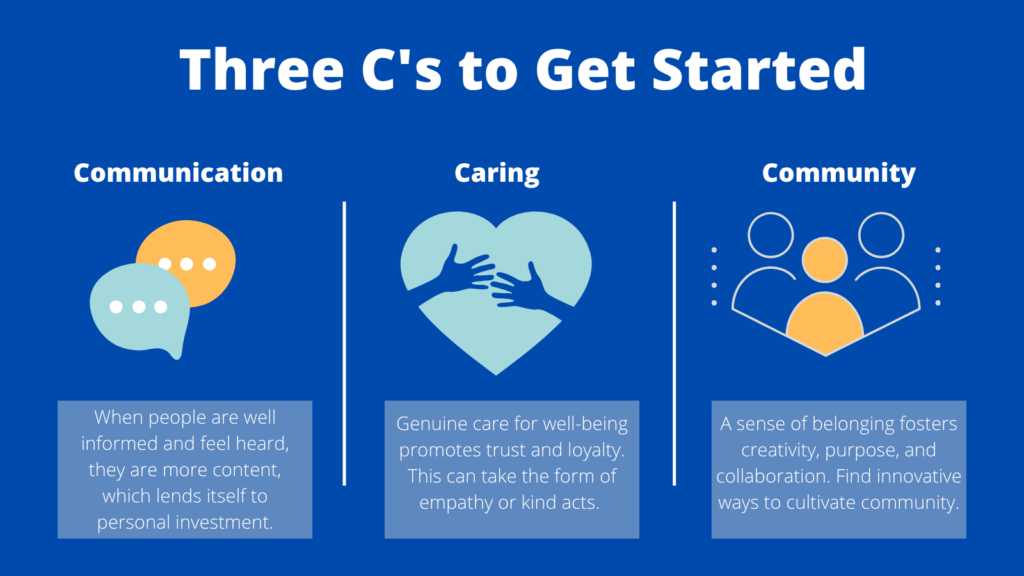
Communication

  • Strive for clarity and make your communication as concise as possible
  • Use multiple channels to communicate the same message 
  • Find ways to integrate your personality as you speak, write, and facilitate discussions
  • Always assume that you’ve under-communicated

Caring

  • Schedule regular check-in meetings
  • Use informal conversations to stay updated on people’s lives
  • Regularly check to see that people’s tangible needs are being met
  • Make mental health a part of creating an environment where people are cared for

Community

  • Encourage and provide the means for networking and professional development
  • Provide opportunities and participate in chances to be together in informal contexts
  • Be mindful of including remote workers and intentional to schedule time together with digital teams
  • Celebrate wins together

I’ve had the privilege to work for leaders who practiced these concepts, and I’ve had the misfortune of serving under leaders who misunderstood or disregarded motivation. The first kind of leader inspired everyone in the organization to strive for greatness, while the second contributed to a toxic work environment.

Motivation probably seems like an abstract idea more than a leadership strategy. It isn’t an easy concept to get your head wrapped around or practically implement. It takes time, willingness to learn, flexibility, and a genuine desire to harness motivation’s power to invest in people. Far more than the practical benefits, motivation matters because people matter.

References

Harvard Business Review, Morten T. Hansen, Teresa M. Amabile, Scott A. Snook, & Nick Craig. (2018). Purpose, Meaning, and Passion (HBR Emotional Intelligence Series). Harvard Business Review Press.

Pink, D. H. (2009). Drive: The surprising truth about what motivates us. New York, NY: Riverhead Books.

Ryan, R. M., & Deci, E. L. (2018). SELF-DETERMINATION THEORY: Basic psychological needs in motivation, development, and wellness. S.l.: GUILFORD.

Schwartz, T. (2014, July 23). The Productivity Myth. Harvard Business Review. Retrieved May 14, 2022, from https://hbr.org/2010/05/the-productivity-myth-2 

Thomas, K. W. (2010). Intrinsic motivation at work: What really drives employee engagement. San Francisco: Berrett-Koehler.

Leadership Communication

Leaders typically identify one of their strengths as communication. Ironically, one of the most common frustrations among followers is poor communication (The Workplace Communications Crisis, 2022). Booher (2017) identified strategic communication as the very core of leadership and stated, “When you as a leader speak, meet, negotiate, write, or network, you either clarify or confuse, motivate or demoralize, engage or enrage employees” (p. 3). Leaders can improve communication skills, and the best leaders will routinely self-assess, conduct audits, and make communication course corrections accordingly. 

Communication is a Two-way Street

The process of communication involves sending, receiving, and understanding information. Sending information does not guarantee that it is ultimately understood. Leaders often assume that an email with an attached memo equals a message received, understood, and on its way to implementation. However, the other half of that equation involves many variables to determine success. 

In the introduction to his bestselling work Surrounded by Idiots, Erikson highlighted the significance of studying people and their communication. “Since I began studying how people function and painstakingly strove to understand the differences in the way we communicate, I’ve never been the same.” Communication involves people with personalities, styles, worldviews, and preferences that likely differ from ours. Acknowledging communication as a two-way street may seem incredibly simple, but it is foundational to improvement.

Communication Involves Communicators

Everyone is a communicator, and each person has a unique style. The differences in communication style can serve as breakdown points or reflection points for effective communication strategy. Leaders who embrace this reality and hone their communication to fit the mutual communicators they work with can see remarkable progress in engagement and execution. 

Not only must information be sent, but it must be received, processed, understood, and ultimately integrated. Conducting a communication audit is a helpful process to identify breakdown points and form a plan to make communication a positive force in organizational engagement and productivity. Leaders must ask when, how, why, and with what frequency information is being shared at all levels. Fine-tuning those aspects with the recipients’ styles and needs in mind goes a long way toward cultivating clarity and contributing to trust, loyalty, and productivity. 

Variation, Repetition, and Repetition

Practically, there is a remarkable benefit to communicating across multiple channels, in varying formats, and repetitively. An email sent, a memo delivered, or a bullet point list at the end of a team meeting does not ensure that everybody has received and is acting on the disseminated information. 

Having multiple touchpoints that include written and spoken formats is a simple but effective way to increase communication impact. Automated communication tools make it easier than ever to set up a communication plan with repetition and variation.

70% of leaders believe their communication is concise and engaging. 60% of employees disagree (The Workplace Communications Crisis, 2022). This disparity is an astounding opportunity for leaders to reflect and grow. Recognizing the dual nature of communication and understanding the personal nuances are perspective shifts that can impact leadership effectiveness in this area. Practically, weaving together a communication plan that incorporates multiple ways of communication numerous times is a simple but powerful strategy to bring clarity.

References

Booher, Dianna. Communicate like a Leader: Connecting Strategically to Coach, Inspire, and Get Things Done. Berrett-Koehler Publishers, 2017.

Erikson, Thomas. Surrounded by Idiots: The Four Types of Human Behaviour (or, How to Understand Those Who Cannot Be Understood). Random House, 2019.

The workplace communications crisis. (2022). Axios.  https://www.axioshq.com/research/comms-report-2022?utm_campaign=comms-report-2022&utm_source=pr summit&utm_medium=email&utm_content=comms-report-2022

Four Leadership Myths

Leadership misconceptions are a dime a dozen. Many ideas are floating around about what makes a great leader and what the best leaders do. After over twenty years and seven different organizations, I’ve seen four leadership myths rise to the surface that need dispelling. 

You Can’t Teach an Old Dog New Tricks

What we now know about neuroplasticity means we can grow in our thinking. Drawing on the advances in neuroscience and brain plasticity, Aldrich (2013) asserted that the previous conclusions of a fixed intelligence quotient were untrue and that the brain continues to develop over time. The adage “You can’t teach an old dog new tricks” doesn’t hold up. Leaders can evolve beyond their dispositions and personalities and cultivate new skills to enhance themselves personally and professionally.

One Size Fits All

All leadership styles are not created equal, and every scenario may require a unique approach. The command style of leadership is powerful and wise in particular circumstances; however, it is also ineffective and unwise in others. Can you imagine a preschool teacher snapping like a military drill sergeant at three and four-year-olds? On the other hand, is it wise for a corporate CEO to tolerate or coddle mediocrity? Different contexts call for different leadership styles and use various tools to fit the situation. 

1950’s CEO Reigns Supreme

Emotionally detached, top-down authority structures emphasizing compliance had their day, but it has passed. Kenneth W. Thomas (2009) described this as a shift from the compliance era to the partnership era. Employees are not mindless drones who take orders handed down from the corporate sage. Treating employees like that will diminish productivity and shorten longevity. Shifting your perspective toward partnership simultaneously unlocks creativity, builds trust, and cultivates a culture of shared vision.

Leadership is a Position

We often associate leadership with a title. However, being at the top of an organizational chart does not make you a leader any more than having a nameplate that says “leader” does. Some of the most influential leaders I’ve ever worked with didn’t have a position. They had earned influence because of their integrity, loyalty, empathy, wisdom, and care for others. More often than not, I’ve found that the best leaders have positions come their way because of respect and recognition. 

As we approach a new year, dispelling some of the common myths surrounding leadership is helpful. Whether you have a title, find yourself starting over in a new place, or have served faithfully with no position for years, understanding these concepts can help you reset your mindset. Learn something new, challenge the stereotypes that impact your thinking, and embrace your influence regardless of your title. 

References

Aldrich, R. r. (2013). Neuroscience, education and the evolution of the human brain. History Of Education, 42(3), 396-410. doi:10.1080/0046760X.2012.749543

Thomas, K. W. (2009). Intrinsic motivation at work: What Really Drives Employee Engagement. Berrett-Koehler Publishers.

© 2026 Theology Leadership

Theme by Anders NorenUp ↑