
Articles on Theology and Leadership

Tag: Law

The Law is Good, but It Is Not the Cure

Imagine entering the sanctuary after having fought back every inclination to stay home. You’re stressed, filled with guilt, and burdened to the brink of despair. The pastor begins the sermon and from start to finish it’s one indictment after the other. The law in all its glorious goodness is wielded well, but the good news is never proclaimed. You’re killed. You’re put on the chopping block of your own inadequacies. Now suppose that happens for three weeks in a row.

On the other hand, what if a congregant came in under the false premise that they had it altogether. Could it be that their piety left them in a hypothetical pristine condition before an Almighty God? Would only a declaration of our right standing before God bring the needed realization that they are utterly dependent on God’s mercy and grace through faith? Now suppose that person is left in their self-righteousness for three weeks in a row.

The law and the gospel are not two sides of the same coin. They do not pay equally. One required repeated offerings from priests but our great high priest sat down at the right hand of God having offered the perfect sacrifice (Hebrews 10:11-2). They both come from the same glorious God with a magnificently merciful plan. Yet, the scriptures make it explicitly clear that the law is insufficient and serves to diagnose humanity and foreshadow the cure to come in and through Christ. Scripture repeatedly emphasizes the diagnostic, killing function of the law. But it also makes it explicitly clear what it was always pointing toward.

The Law Brings Wrath (Romans 4)

As Paul elaborates on the faith of Abraham, he reminds us in Romans 4:15 that the law brings wrath. Paul is making the bigger point that God’s promise is delivered through faith and expands beyond Abraham’s descendants in the flesh. In fact, Paul says in verse 16 that the very reason it depends on faith is so that the promise may rest on grace, not on adherence to the law. It is because of justification by faith we have peace with God through Jesus Christ (Romans 5:1). The apostle will draw this distinction even more sharply in Galatians.

The Law is a Curse (Galatians 3)

Paul holds up the exemplar of justification by faith again and repetitively connects the law to the curse of humanity. How can we who received the Spirit by hearing with faith revert to thinking we are perfected by the flesh (Galatians 3:2-3)? Again his emphasis is on the expansion of the gospel to all nations to those who accept our guilty verdict under the law and look to Christ as the one who redeemed us from the curse of the law through faith. The law was our guardian for a time, but Christ came and we were set free through faith. What a blessed curse!

Good Law, Bad Sin (Romans 7)

Is the law the bad guy in our story? Absolutely not! The law is “holy, righteous, and good (Romans 7:12).” Yet, the function of the law is to reveal the killing nature of our sin. But the law is not sufficient to resurrect us to new life. Neither can the law produce the righteousness it demands. Our sin is ultimately disqualifying and damning. The law awakens us to this reality of sin and death and only Christ’s atoning work on our behalf fulfills the requirement of righteousness God demands for those who walk according to the Spirit (Romans 8:1-4). The law’s inability to save isn’t because it is defective. It’s because we are.

The Law is a Shadow (Hebrews 10)

The law has only a shadow of the glorious and gracious realities of Christ. In Christ, we have not a reminder of our sins but instead the forgiveness that remembers no more through Christ. The law is not merely written on stone tablets, but supernaturally on our hearts and minds even as he remembers our lawless deeds no more. As good as the law was, and it was good, it was always pointing toward something (someone) greater.

The Veil Lifted (2 Corinthians 3)

The law carved in letters on stone was so glorious that the people could not behold the face of its messenger. How much more so is the glory of the eternal logos with God’s redeeming justice carved into His very body for our salvation? When reading the old covenant and turning to Christ, the veil is lifted for us to behold the invisible reality of faith. To neglect or relegate what the law was always pointing to is to put the veil back over our hearts. Let us not put blinders on or limit the hearers of God’s word from seeing the glorious reality of Christ through and through.

The Law is Good (Psalm 119)

God’s word is steadfast, powerful, instructing, steadying, encouraging, lifting, and good.

17 Deal bountifully with your servant,
    that I may live and keep your word.
18 Open my eyes, that I may behold
    wondrous things out of your law.
19 I am a sojourner on the earth;
    hide not your commandments from me!
20 My soul is consumed with longing
    for your rules at all times.
21 You rebuke the insolent, accursed ones,
    who wander from your commandments.
22 Take away from me scorn and contempt,
    for I have kept your testimonies.
23 Even though princes sit plotting against me,
    your servant will meditate on your statutes.
24 Your testimonies are my delight;
    they are my counselors.

Yes, the law is good but it is not the cure. Humans aren’t robots with bad code who need to download better data to fix our operating system. We are complex beings created in God’s image with minds, bodies, desires, and wills. We are sinners through and through. The law is the standard we are measured against because it is a reflection of the very character of our perfect God. It tells each and every one of us not just where the little problems are but that we have a bigger problem. Put another way, our problem isn’t just that we sin but that we are sinners by inheritance. When the church neglects preaching the law and the gospel week in and week out it either provides false assurance for the religious pharisee types or burdens the consciences of the broken reeds among the flock.

A Messianic Example ( Luke 24)

When the resurrected Christ opened the minds of His disciples to understand the law, it was to point toward His fulfillment of all the law of Moses, the Psalms and the Prophets said. He summed it up perfectly: “Thus it is written, that the Christ should suffer and on the third day rise from the dead, and that repentance for the forgiveness of sins should be proclaimed in his name to all nations, beginning from Jerusalem (Luke 24:46-47).”

Rest in the Law of the Spirit (Romans 8)

Lest I fall into the same trap of neglecting a law and gospel approach, I hope that you’ll feel the weighty freedom that it gives as we meditate on Romans 8. You and I were under the law of sin and death. Not only are we guilty before a Holy God because of our inherited state from Adam, we are guilty because of what we’ve done today as compared to God’s character and law. But God did what the law couldn’t in sending His only Son in the flesh to fulfill the righteousness required on our behalf. We have received the Spirit of freedom in Christ, so we are told not to fall back into fear or slavery. If God is for us, who can be against us? “For I am sure that neither death nor life, nor angels nor rulers, nor things present nor things to come, nor powers, nor height nor depth, nor anything else in all creation, will be able to separate us from the love of God in Christ Jesus our Lord (Romans 8:38-39).”

The law gospel distinction is often painted as a caricature of cheap grace. That criticism misses the point altogether. It’s ironically neglecting the law and gospel distinction that leads to cheap grace because it either drives us to despair or lulls us into presumption. Understanding and consistently preaching the law and the gospel in their respective slaying and resurrecting power neither coddles the self-righteous nor berates the broken. Such proclamation leans into grace, shatters any notion of merit, and provides the balm of Gilead for injured souls. We should preach the law so stringently that Paul would have to describe it as killing. We should preach a gospel so free that Paul would have to answer objections because grace is offensive.

The Paradox of Obedience and Motivation

When does God despise obedience? Why would God command us to do things in specific ways with full knowledge of our depravity? These are not simple questions, and it will take many layers to work toward understanding the beauty, mercy, glory, and goodness of God in our obedience and motivation. Despite the seeming complexity, the through line is the simplicity of Christ crucified and risen to become our righteousness in deeds and desires of omission and commission.

Right Sacrifices and Wrong Obedience

God instituted the sacrificial system, so why was He displeased by the obedience of His people to follow it? Amos 5:22 identifies the issue. Psalm 51:16-17 identifies the problem as well and also points toward the answer. God despises obedience when our actions become mere rituals disconnected from His character and devoid of His steadfast love. 

Hebrews 9 outlines God’s perfect plan foreshadowed and embodied in the person and work of Jesus Christ. Sacrifices rightly offered were always more than ritualistic obedience. They were copies of heavenly things that pointed toward Christ’s once-and-for-all sacrifice, not in handmade representations, but in the eternal reality of redemption in Heaven itself. Sacrifices rightly offered are those done in complete obedience, with pure motivation, and in connection with the lamb of God, who takes away the sins of the world. 

The Sermon that Exposes Us

As Jesus “went throughout all Galilee, teaching in their synagogues and proclaiming the gospel of the kingdom” (Matthew 4:23), He went up the mountain to sit down and teach. Love my friends? I’m not great at maintaining even those most precious relationships. Love my enemies? That is an impossible command. Jesus’ sermon on the mount intensifies the reality of our depravity by highlighting the necessity of pure inner motivation rather than mere outward compliance. 

The sermon on the mount is, in part, the great equalizer of anyone under the mistaken impression that they might scrape by in personal adherence to the law. Behavioral modification isn’t enough. The notion of innocent, law-abiding Christians is an illusion. We are all sinners in word, deed, and desire. Matthew 5:48 reminds us of what God requires, and Romans 3:21-28 explains how the justification of sinners takes place. 

Out of Nothing, Outside Ourselves

But if the sermon on the mount exposes our inability, how then is faithful obedience even possible? Latin is a dead language, but two terms help us understand our natural status and how God supernaturally works. Ex nihilo means “out of nothing” and typically refers to creation. God created “ex nihilo.” Extra nos means “outside of ourselves” and usually refers to salvation. Salvation is “extra nos.” 

Out of nothing, God creates faith outside ourselves. God works through the means of grace by His promises. He promised that baptism kills and resurrects (Romans 6:4, Colossians 2:12). He promised that His body and blood in the supper were for the forgiveness of sins (Matthew 26:28). Faith comes through hearing and hearing through the word of Christ (Romans 10:17)! He will do what He promises, won’t He? In the emptiness of our incapable depravity, He gives grace upon grace. We cannot bridge the gap between our obedience, motivation, and God’s expectation of righteousness in word, will, and deed. Out of that deadness and outside of ourselves, Christ’s death and resurrection deliver life just as God promised. Yet, we must be vigilant to rightly understand and live in light of these glorious, gracious realities. 

Legalism and Antinomianism 

Legalism is the elevation of the law to the level of Christ’s sufficient work on the cross. In contrast, antinomianism is the relegation of the law to a level beneath God’s righteous and required commands. Both of these are a constant danger to the church. If you need to strike the balance, read the book of Romans. The oracles of God are a blessing. The law of God is holy, righteous, and good! Yet, it is insufficient to justify.

The law of God is good. Psalm 119 is a powerhouse testimony to this indisputable fact. Across 176 verses, this acrostic Psalm celebrates the blessedness of God’s statutes, promises, testimonies, laws, precepts, and righteous rules. “Righteous are you, O Lord, and right are your rules. You have appointed your testimonies in righteousness and in all faithfulness” (Psalm 119:137-138). But the law in all its goodness (Romans 7:12) could not satisfy the righteous demands of God within us (Romans 8:3-4). Jesus did not come to abolish the law but to fulfill it. We constantly struggle to understand that the law of God must not be “relaxed” while simultaneously understanding that only Christ has fulfilled it in word, will, and deed on our behalf. How can we best remember that Christ has lived it while we can only live in light of it?

Law and Gospel 

Finding the middle ground between these two extremes through a proper distinction between law and gospel is what we see in scripture. Muddle the two, and you strike at the very heart of justification by faith alone. What distinguishes the law from the gospel? The law says that you must do while the gospel says it is done. The law threatens while the gospel promises. The law proclaims condemnation, while the gospel announces justification. 

Read through the book of Galatians, and you’ll see this distinction. Paul adamantly emphasizes that a person is not justified by works of the law (Galatians 2:15-16). Is the law contrary to God’s promises? Certainly not! (Galatians 3:21). Yet, look at the way that Paul describes believers’ relationship to the law in his confrontation with Peter: “But when I saw their conduct was not in step with the truth of the gospel.” It’s relying on the works of the law that brings the curse (Galatians 3:10). We are justified by faith, and as believers, we are called to live our lives in alignment with the truth of the gospel. However, our faithfulness to living in such alignment is not what justifies. Christ does that (Romans 7:21-25 and Romans 8:1-4)!

Go and Learn

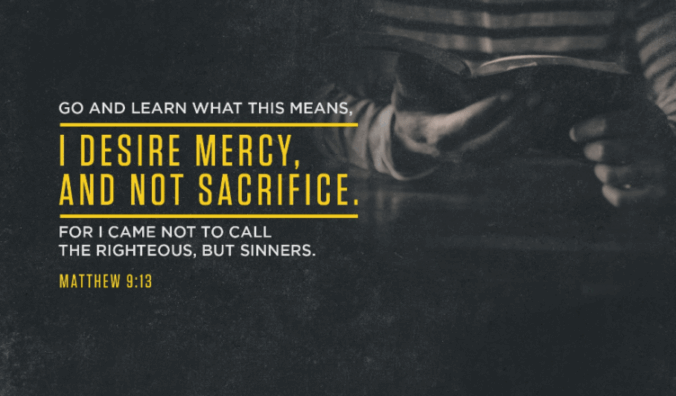
In two instances in Matthew’s Gospel, Jesus quotes Hosea 6:6 and points the Pharisees to the importance of contemplating mercy. The first is after Matthew’s call, and Jesus is reclining at the table with sinners. The second is after the disciples eat heads of grain on the Sabbath. The Pharisees cannot see past their righteousness enough to discern the nature of God’s disposition toward humanity nor His purpose in sending His only begotten Son. Knowing the law full well, they missed the incarnate word standing in front of them! His words to them on both occasions? Go and learn what this means: “I desire mercy and not sacrifice.” We must not deceive ourselves that it’s others who must go and learn. We need to go and learn what this means.

When it comes to obedience and motivation, we tend to think in terms of carrots and sticks. Heaven is a carrot. Hell is a stick. The law is a stick. The gospel is a carrot. But our God is doing something greater than pushing or prodding us along to jump through behavioral hoops. We are not lab rats in His cosmic maze. He supernaturally creates faith where there was none and then faithfully sustains it through His promises. The paradox of obedience and motivation is that, on the one hand, God requires perfection, and on the other hand, He embodies it and applies it to all who believe in Christ by faith. 

Why does God despise heartless obedience? God despises heartless obedience because we can do it on our own. It bypasses Christ. God despises heartless obedience because it is merely transactional in nature. He is a relational God. 

What does obedience require? Obedience requires an alignment of actions with scripture as well as a posture of the heart attuned with Christ by faith. Obedience necessitates not only our deeds but also our wills to operate in alignment with God’s truth. In other words, obedience requires supernatural intervention. In the final analysis, the paradox of obedience and motivation is no paradox at all. Obedience doesn’t earn righteousness—it reflects the righteousness already given by grace through faith.

A Prescription for New Wine

After nearly thirty years as a believer and fifteen in the ministry, this is perhaps the most difficult topic I’ve felt compelled to address. The difficulty comes because of the pharisaism in the first half of my Christian walk and ministry. As one childhood friend put it, “you’re so uptight if you ate coal, you’d get a diamond.” He was right. After a lot of study, ministry, failure, sin, and experience, I’ve come to understand that the gospel is the antithesis to the rigidity and self-righteousness I espoused, and that still haunts the hidden corridors of my heart.

A Prescription from Pharisees

The Pharisees sought the protection of their image and heritage. They were more concerned with the appearance of righteousness than actually possessing it. So, their call was to follow the rules. Wash your hands, abstain from healing on the Sabbath, and by all means, don’t associate with tax collectors and sinners. However, their prescription only addressed the symptoms and failed to understand the underlying cause of dead works.

If I’m honest, I’ve handed out more than my fair share of diagnoses and remedies over the years. More concerned with ensuring everyone toed the line, I was obsessed with behavior modification even if it was for the glory of God. What I misunderstood was that glorifying God involves more than merely doing what God has commanded. Amos 5:18-25Hosea 6:6, and Psalm 51:16-17 reveal that there is a way to offer God precisely what He has commanded that does not please Him. Jesus’ intensification of the law in Matthew 5:17-48 demonstrates the need for a righteousness that exceeds that of the Scribes and Pharisees.

A Prescription for Pharisees

Jesus’ prescription for the Pharisees was not righteousness, but rather a recognition of their unrighteousness. His prescription was new wine; a wine that would explode the old wineskins of their expectations and religious bureaucracy. When Jesus pronounced forgiveness of sins to the paralytic in Matthew 9, the scribes cried, “blasphemy!” When the Pharisees saw Jesus eating with tax collectors and sinners they questioned His disciples. Jesus’ response is a quote from Hosea that should strike us with the same force that it struck them: “Go and learn what this means: ‘I desire mercy, and not sacrifice’” (Matthew 9:13).

Then, John’s disciples approached to inquire about fasting. When Jesus replied, it was clear that something explosively new had come. What need is there for fasting when the incarnation of the entirety of your faith is right in front of you? What the Pharisees needed instead of obedience was to actually understand the very nature of God’s mercy as put on full display in the person of Jesus. That kind of divine mercy transforms one from the inside out and produces vibrant and joyous obedience instead of stale and begrudging obedience.

A Prescription for New Wine

Beware the arrogant, self-righteous ones who care more about you affirming their interpretation of scripture than understanding the gospel in all of its offensive glory. They hand out verses of scripture as if from a prescription pad like they wrote it themselves. Ironically, they miss their sickness and the real healing power of Christ’s atoning work. Like archaic doctors, they still attach leeches to their patients and seem dumbfounded by the resulting death.

The new wine of the gospel doesn’t offer a panacea for all our problems, but it does provide a cure for our most significant problem. Looking to and exclusively trusting Jesus Christ, His perfect life, His atoning death, and His glorious resurrection on our behalf is the sole sufficient remedy for our depravity.

What we need most is not more engaging preaching, more marks of healthy churches, more stringent adherence to our ethics, or more ardent defense of our theological presuppositions. Those prescriptions have been handed out in droves. Instead, we need to herald the unbelievable good news of the Son of God hanging on a tree to satisfy God’s wrath in our place. Once that is done consistently, then the conversation about other prescriptions can begin. After all, what use does a dead man have for wine at all?

© 2026 Theology Leadership

Theme by Anders NorenUp ↑